
They stand secluded.
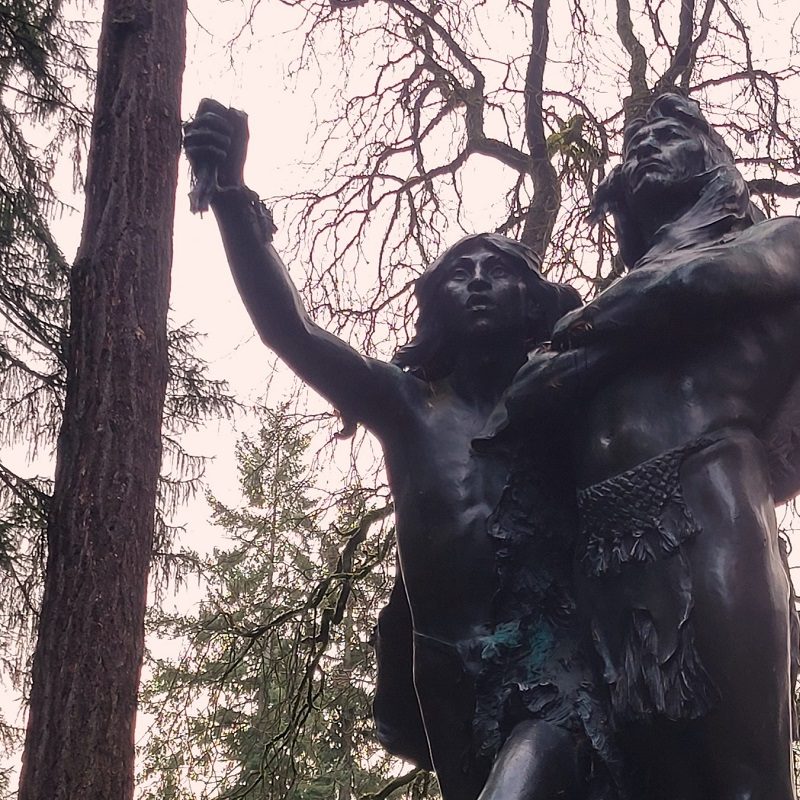
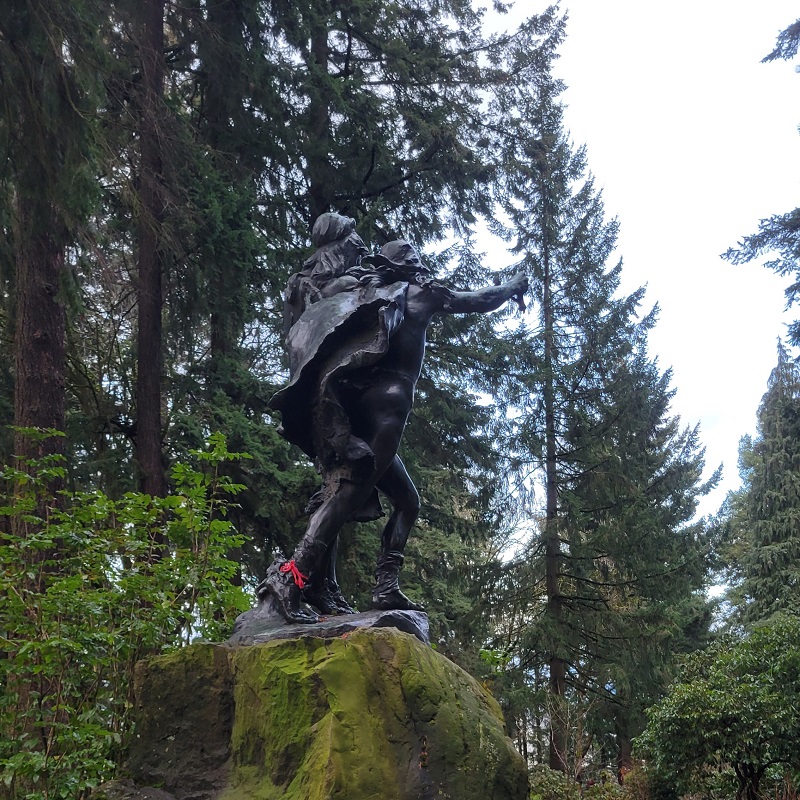
Two persons—ostensibly men, ostensibly Native American—remarking on some portent. One stands cross-armed, the other holds what was a fir branch, now broken and removed, and motions it toward the distance. The tree cover obscures what must have captured their attention so. But the straight-line direction inevitably leads to the Willamette River, and, going further, the Columbia.
The statue is titled Coming of the White Man and the grounds for the subject’s gestures are the Lewis and Clark Expedition. My running route crosses that statue every time I ascend the hills and switchbacks of Washington Park.
In some ways, I consider them as guides, as friends. An encouragement that I have reached the halfway mark of my regular run and that it was (mostly) all downhill from there. And while they are secluded in a northeasterly corner of Washington Park—one could walk the rounds for the first time and only find them by happenstance—these guides sit within a loop and next to a parking lot, confronting anyone who finds them with questions of ethics, should they have enough of a philosophical mind.
Is it correct in its depiction? Or is it only correct in how one understands that depiction?
Their history is remarkably checkered. The placement and dedication of the statue was made in 1904, during a centennial to celebrate the expedition, as a gift from David P. Thompson.
Jeffrey Uecker, writing for the Oregon Historical Society, tells that one dedicatory speech proclaimed “[They] did not know that before civilization’s march barbarism falls, as disappears the dew before the rising sun.”
Mayor George Williams lauded the historicity of the statue. Remarking on them as “not the Indians of poetry or romance, but real Indians as they were when the star of empire burst upon their vision.”
This is a gentrified kindness; all I see is the Noble Savage myth put to bronze and placed atop a boulder plinth.
In grade school, it is taught how Merriwether Lewis and William Clark, and their party of thirty men forded down the Columbia River to the Pacific under the auspices of Sacagawea. How along the way, they bartered with the local tribes, gifting medals minted with a messages of peace. How every bird, every flower and every river was painted, pressed and mapped.
Energy is not, however, spent on telling children how one of the party was an enslaved black man, York, and that he was allowed to vote on company matters. Nor that Sacagawea was not originally hired by the company, her husband Toussaint Charbonneau was. Nor was she willingly married to him; kidnapped in a raid by Hidatsa, the Shoshone Sacagawea was barely a teenager when she was won by a gambling Charbonneau.
These are all nuances saved for a later date. When that later date comes, who can say. But for a large degree of the Pacific Northwest, the expedition of Lewis and Clark is very much the regional variation of “In 1492, Columbus sailed the ocean blue.”
Hold on, let me try something here.
“In 1804, Lewis and Clark hunted the Pacific door.”
Hmm, that’ll have to do for now.
There’s an iconography, a memetic property to the history of the United States writ large. Perhaps all of human history, to be fair, but speaking colloquially, the United States has a history told in images. The crossing of the Delaware, the signing of the Declaration of Independence, the assassination of Abraham Lincoln, the raising of the flag on Iowa Jima, Neil Armstrong’s first steps on the moon, the Twin Towers on September 11.
A thousand words, they say, a thousand words. But it’s become clearer and clearer to me that nuance does not seem to be one of those words. Nor context. I should no longer be shocked at this point. Enough Americans are just willfully ignorant of the layers to the history, content to let the images be the story.
But not that’s what frustrates me as I stand, taking a breath and gazing over the detail of this Multnomah chief and his wiseman. What bothers me is that, despite all of the problematic things one could possibly bring up about the subject, history and praise, I like the statue.
Patrons receive early-access to monthly poetry, short stories and short films as well as exclusive access to Patron-only short stories, poetry, and behind-the-scenes content. Every additional Patron lets me continue my dream of being a full-time creative, and I appreciate your support.

 The Casual Ramble