
Well, I promised I’d write about Kingdom of the Planet of the Apes and, despite it taking a while—so long in fact, that I had to rewatch the film—we’re here now.
Without delving too far into comparisons, I think it’s fair to say this film is multiple touches better than Gladiator II. Not an earth-shattering revelation, but one that allows an accounting of the subtle arts of filmmaking. There are still problems of course; certain plot elements are more or less forgotten and the physical properties of water are completely misconstrued. But I’m not a physicist, nor am I inclined to be one when so many other aspects of the film, the characters, world and plot, are done with a deft touch.
And to completely level with you; I’m not a cinematic fanatic. I’ve seen far less movies than I ought have to be a cultured critic or make a best-of list year after year. The trick is that I’ve seen just enough that I can appreciate a good juxtaposition of protagonist and foil, the sensations inspired by the movement of a camera and a solid base for film history.
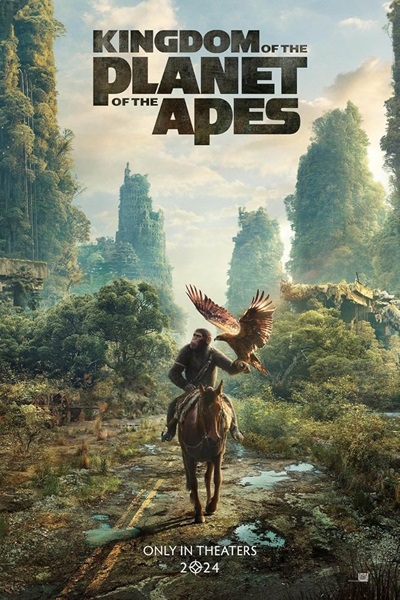
This movie has all of it. Script writer Josh Friedman delivers a sturdy story structure, while director Wes Ball and cinematographer Gyula Pados keep a dynamic camera that both emulates prior entries into the remade Apes series and a natural documentary for a consistent film.
Consistent is perhaps the best adjective for Kingdom. The plot is a slow burn retelling of the hero’s journey. A film after Joseph Campbell’s own heart. The characterization of every character is easy to read by their expressions and actions, not just by the words on a page.
Owen Teague gives a workman’s performance as Noa. The spectacle of his acting does not rest in a moment, but the consistency of moments. His expressionism and nonverbal acting never falls off, nor does it take off. If there is a failure in him having a great moment of cinema, it’s a matter of the film having to juggling more plot points than needed1 as well as recycling others from past films.
The same can be said for tritagonists Freya Allan and Peter Macon in this film. Because their characters have more obscured motivations, however, their character moments come with far more dynamism. Peter Macon, in particular, is a highlight as the orangutan Raka. A true follower of Caesar, Raka serves as the bridge between the Andy Serkis series and the Wes Ball series, providing the moral compass of the film. Moreover, Macon and Allan have by far the best dramatic/comedic moments of the film.
In contrast, Kevin Durand is a delight as Proximus Caesar, delivering a corrupted yet charismatic facsimile for Serkis’ character. The conflict between Proximus and Noa places much of its dynamic within the evolving social order of apes and speaks to what this film does best.
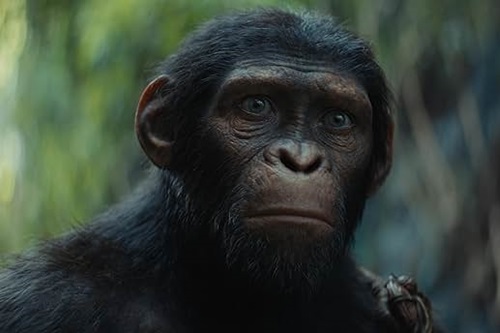
Owen Teague as Noa 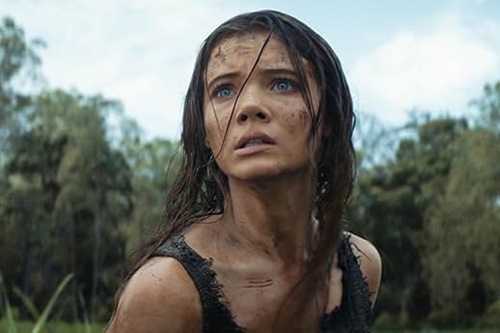
Freya Allan as Nova 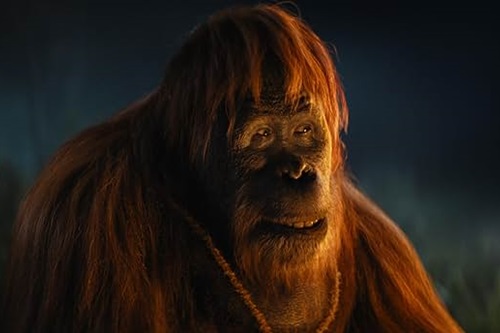
Peter Macon as Raka 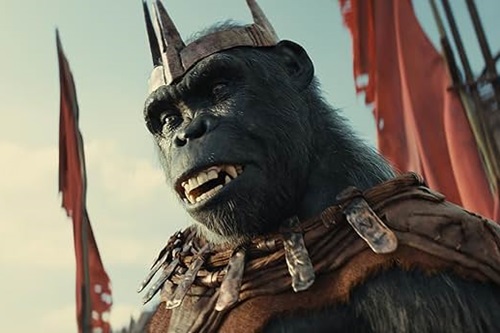
Kevin Durand as Proximus Caesar
Generations removed from the first trilogy, Noa’s clan of apes, while a similar polity to Caesar’s tribe, has developed philosophically apart. Their social order rests at a hunter-gatherer technology level, communing with eagles and building homes from the skeletal frames of transmission towers but they have no common history. This is a tribe that reflects where the new Apes series is coming from.
In direct opposition lies Proximus Caesar’s kingdom. Polluted with legends of human and ape history, Proximus’ position conflates the god-emperor iconography of the late Roman Empire with the prophetic legend of Caesar to invoke a divine right of kings. This conflation justifies not only his right to rule, but the ascension of ape over man. This is what the new Apes series is heading toward.
From the standpoint of anthropology, it’s a fascinating first film in a potential series. From the standpoint of cinema, however, it receives plenty of gripe for how it sets itself up as the first in a new series.
Noise about how cinematic universes make for films that suffers on their own is not news. Hollywood has thrown itself deep into obsession with this paradigm since Disney bought and financed Marvel Studios. But the thing is, many great films leave their audiences with a desire to reenter that realm of imagination. Even Star Wars left audiences with the impression that another story could be told. It’s not a qualifier to be a great or even solid film, but it’s no sin either barring serious quality issues.2 By all accounts, the difference between “series” and “universe” blurs within a spectrum.
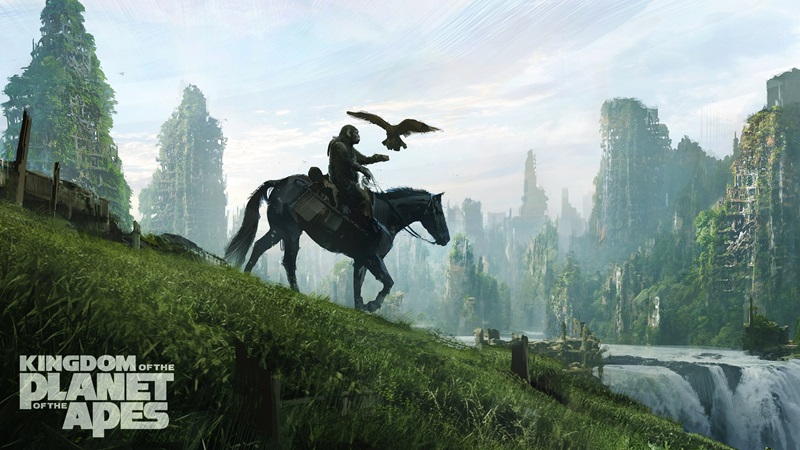
Friedman and Wes Ball’s decisions as filmmakers err toward series. While it does connect itself to the overarching universe, the story itself is not bound to the original as if it were a code of law. The Serkis series did the hard work of building the sandpit, and now Ball is just taking the next logical step by building the castles; building the kingdom.
Far more penetrating is how the film dances with self-reference; how it courts the danger of falling too deep within that desire to find inspiration in nothing but its own source material. To borrow Star Wars again, this is precisely the problem with the greater portion of Disney’s Star Wars projects. The sequel trilogy, latter seasons of The Mandalorian and Ahsoka all rely heavily on relationships developed in prior series. Even Andor, the magnum opus of Disney’s new canon, is enhanced by literacy with the original trilogy and Rogue One.3
Should this new series of Apes films fall into such a trap, it won’t indict the quality of Kingdom of the Planet of the Apes. It won’t even key critique toward Wes Ball and Josh Friedman for their efforts on Kingdom. It’s a bill of criticism that remains hypothetical. In the present moment, audiences can enjoy how scenes and sets call back the original film from 1968 all the while propelling the universe into the 2020s.
That’s what transforms this film from simple spectacle that might best be left as is and into a step-stone toward the great unknown. And I much prefer a project that believes earnestly in taking that step than one that doesn’t.
Patrons receive early-access to monthly poetry, short stories and short films as well as exclusive access to Patron-only short stories, poetry, and behind-the-scenes content. Every additional Patron lets me continue my dream of being a full-time creative, and I appreciate your support.
1 The story, while well crafted, does diverge from the relationship between his clan and the eagles after the first 30 minutes in such a way that reduces the impact of Noa’s resolution to action, and creates an ex machina effect for the film’s climax.
2 If you’ve seen the Three Musketeers film from 2011 with Orlando Bloom and Mila Jovovic, you know precisely what I’m talking about. That film ends on a cliffhanger that it absolutely does not deserve. But I admire the audacity of self-belief.
3 Thankfully, it’s not required to enjoy Andor. Showrunner Tony Gilroy is a bit of an iconoclast, the series feels more like a gritty political thriller from the seventies rather than a lock, stock and barrel Star Wars show. Strip away all the facade of Imperial crests and the image of Star Destroyers, and the series could equally be a prequel to Isaac Asimov’s Empire as it is to Star Wars. And that’s because Gilroy understood a basic precept of the original trilogy: the Star Wars setting by itself is not interesting, what is interesting are what disparate elements a director or showrunner can transmute into a Star Wars setting.

 The Casual Ramble