
I am not a fan of horror movies. Not in the grotesque sense that is, the contemporary sense. Gore, blood, mutilation, shock. These are not for me.
It’s the largest reason why I had to stop watching Stranger Things. I was largely fine with the monsters, but the moment the kids started melting into flesh bubbles and cripple from boneitis, I knew my time was done. Not all horror movies and television today are like that, of course, but it is the strain that sees the most funding and promotion from the biggest studios. And I’m willing to agree to watch A Quiet Place, or Get Out were the opportunity presented.
I’m just not going to watch a movie like that on my own. More to the point, I find the “horror” as a metaphor either fails to exist or is planted too firmly in the obvious. Oh, the monsters are revolting, sure, but is that all? Does Hollywood just consider audiences a target for revulsion? How ultimately uninteresting.
Instead, I turn to find the horrifying message inside movies which are otherwise geared towards drama. It’s for that reason I was surfing through YouTube Movies last Thursday, looking for something that wasn’t The Terminator or The Thing. It’s for this reason that I settled on Glengarry Glen Ross, and after nearly two hours, I was convinced.
I was convinced that Glengarry Glen Ross is a horror movie.
Let me elaborate: the James Foley film explores every element of the psychological horror from David Mamet’s 1984 stageplay about a small sales office in New York. Real estate, cars, stationary supplies, it does not matter, this is a film made to relate with the psychosis of quotas and closing the deal.
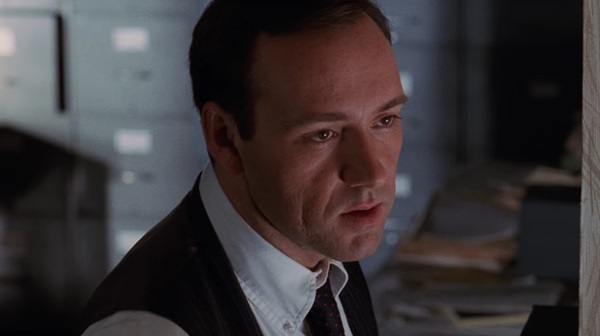
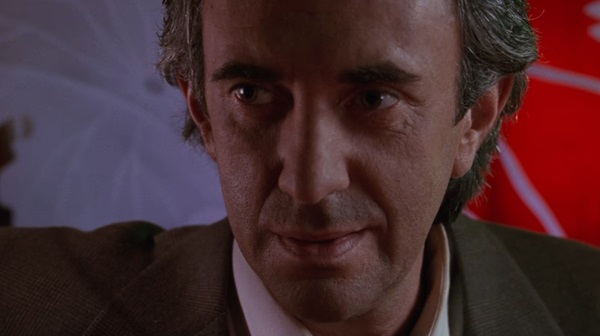
It starts with the faces of each of the principal actors. There’s the uncaring inevitability found in the cold indifference of John Williamson’s face (portrayed by Kevin Spacey), an office manager calmly watching his salesmen tear him and the agency apart. The mortifying dress-down from Blake (a classic, censuring performance from Alec Baldwin), an angel of death for the offscreen Mitch & Murray posing the guillotine over these flailing salesmen.
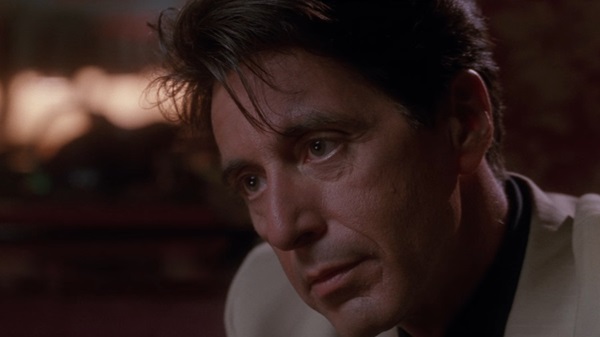
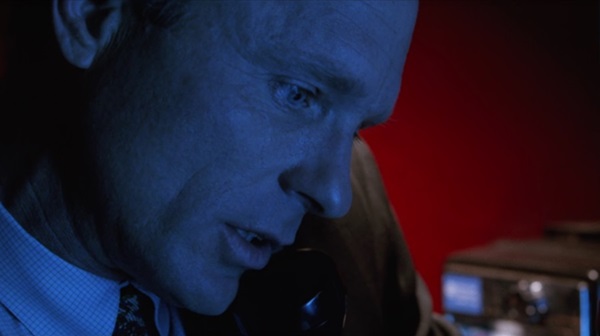
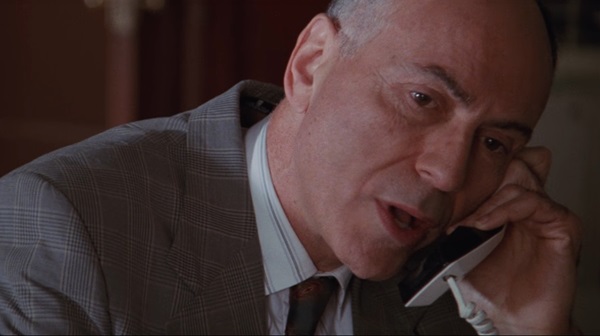
A depressive existentialism reads across Alan Arkin’s face as George Aaronow, a downtrodden facing a Sisyphean task in trying to close. And then there’s the simmering rage within David Moss as played by Ed Harris, whose combustive episodes tick on a timer. The horror slicks and greases its way through the words of Richard Roma, a shining Al Pacino performance and his non-attempt at a New York inflection, selling by way of tautology to the enchanted and hapless Jonathan Pryce as James Lingk.
Finally, it’s evoked to its fullest extent by Shelley “The Machine” Levene, portrayed by a masterful Jack Lemmon. It is nothing short of a Dr. Jekyll and Mr. Hyde performance from Lemmon, as he switches from friendly catechism to invective anger to enclosed melancholy by the scene. The potion seems to be Williamson, whose very presence bubbles each of his employees into a caustic fury brought on by months of low-support and office gamesmanship.
It’s a characteristic of every cast member—it has to be. Every cast member is given a chance to display how salesmen are the ultimate actors. How they morph into another being. They transmute from profane-laden professionals to friendly specters speaking over the phoneline, vampires that only need their mark open the door or demons that requisition an exorcism of no after no to put them out. But in Lemmon, this man-monster performance is most dramatic.

Hey there! Casual Rambler here, just wanting to thank you for reading my blog. I try to avoid marketing myself and I don’t like paywalling content. That’s why most of this website, if not all, is free. However, subscribing to my Patreon helps me keep doing it. Patrons gain exclusive short stories as well as early-access to monthly poetry and photography posts. Thanks again and please enjoy the rest of the site!
I remember what it was like to be in sales. It was for roughly two-and-a-half months. A blink of the eye to real experience, but it was door-to-door and it was for a good product: fresh fruits and vegetables sourced from local farms across the Pacific Northwest. And yet, this still was met with far more nos than yeses.
In the training, the first thing I was taught was that a sale does not begin until after the third no. A person will say no reflexively, as a matter of course. A “good” sales representative pushes through this—they may not even register it—and continues to offer a prop, a brochure, what-have-you with information. The second no comes with a reason; cost, need, skepticism. That’s where the prop comes in. The third no is usually a call for reinforcement; “the spouse is out of town; they control the money,” et cetera, et cetera.
This is where “the deal” enters: “The first box of fruits and vegetables is free; I can throw a free jug of milk in with your order; you have a week to decide if this right for your family; it’s a limited-time offer,” et cetera, et cetera. And this is where it turned… less than ideal. After the third no, a sales representative is taught to just keep running in circles. To go back from the top.
Once again: real estate, cars, stationary supplies, it does not matter. Every sale is a battle of wills and the sales representative must “fuck or walk,” as Baldwin’s venomous Blake puts it.
Blake’s whole monologue is as delicious as it is debased. Horror permeates the scene, nay, the script writ large. There’s Roma’s opening declaration; a claim that it was “so hot downtown this afternoon, grown men on the street corner were going up to cops, begging the cops to shoot them.”
Even more terrifying is Moss’ “times are tough” and that “money is tight,” reflecting the everyday horror that the economic system is the monster threatening to upend the worker through no fault of their own. Still there is the insanity of those old leads; every member of the sales team repeats the same line, that the leads are garbage despite reassurances and lambastes from management that their opportunities are solid. They’re ancient messes, regurgitated and fed to these injured real estate hawks as if they were fledglings.
More importantly, none of the dialogue truly finishes; lines are cut off by another. Characters speak in the dialect of the schizophrenic. Haunted sentences where nary a nervous thought reaches completion, is finished by another cast member, or is left to audiences to fill in the gaps. It’s a cacophony as profane and erratic as a free jazz solo. Every character either falls back on the blues or blue language as they descend further into the depressive malaise of a bad luck set in nowhere, New York city.
It’s why I left that position; I was not keen at all to go off in circles, to go back from the top. The third no was enough—if I did not receive a change in tone or interest, then fuck it, I was walking to the next house. My interest was not in pissing off a stranger at their doorstep. Eventually, that was still too much.
The job was too much. A tough racket, no matter how good, or honest the product could be. Forget food baskets, people will say no to a free handjob from Jesus Christ even if the Lord and Savior were to show up at their door. It’s too good to be true, they would say.
The setting for Glengarry Glen Ross stays largely within the cramped confines of spaces large or small; payphone booths, restaurant booths, the cab of a traveling car, the living room couch of a prospective investor. The only time that the characters have any space at all occurs when they transition on the street. When the set is not cramped, Foley uses the camera to pull in on the characters and cut off the surroundings. The roomiest set could be the Chinese restaurant across the street from the firm, but its low ceilings and red-yellow-green glow all speak to a smoky den.
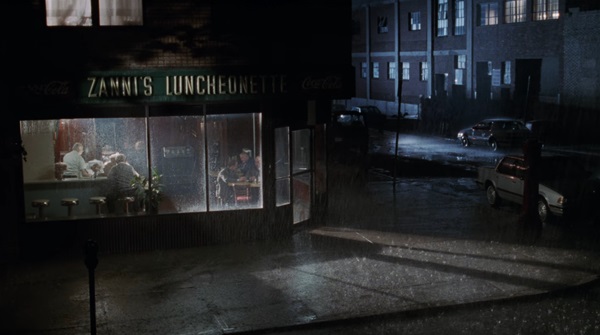
The office, meanwhile, despite its higher ceilings and windows looking out to the street, has all the life of black mold on a linoleum floor. The blinds screen out any context beyond a stormy night—an omen should any one of the four salesmen leave to make it on their own—or the vague brightness of late morning. The outside world does not matter to the internal world of the salesman and it only adds to the pressure.
These mundane settings are frightfully relatable. Sitting on my bed in a 500 square foot apartment near downtown Portland, I can hear my upstairs neighbors’ bed creak. Working at my computer, I hear a next door neighbor hack up another month-old clam. And in my living room, I’m pretty sure everybody can hear the proliferous profanity coming from this film. It’s just that loud in an otherwise quiet piece of cinema. To be this close to others is to be constricted to their choices, their vagaries, their vices. The next-door dog barks, the ambulance sirens, and the night-crawlers holler.
For the salesmen, their money is made when they can limit these external distractions, when they can isolate their clients from spouses, lawyers, and other appointments and beat down every viable defense to the point of insanity.
“Hell is other people,” wrote Sartre. “I won’t live in it,” responds Mamet.
At the end of the film, Pacino’s Roma delivers the line that best sums it all up, “you never open your mouth until you know what the shot is.”
When the camera centers on Lemmon’s veteran face—one worn with the realization that he misjudged the shot—before he enters his supervisor’s office, Pacino’s character can only shrug his shoulders and go out as Arkin’s Aaronow puts aside a tumultuous night and calls up the next client. The credits roll and Al Jarreau sings “it’s nothing but blue skies from now on.”
If that doesn’t horrify audiences about the ruthless apathy of capital living, about the desperation that turns men into monsters, then the audience wasn’t worth saving anyhow. As for me, I sat there, entirely shocked at what was ostensibly sold to me as a drama about salesmen.
What I saw instead was a horror flick about an open-air insane asylum.
Patrons receive early-access to monthly poetry, short stories and short films as well as exclusive access to Patron-only short stories, poetry, and behind-the-scenes content. Every additional Patron lets me continue my dream of being a full-time creative, and I appreciate your support.

 The Casual Ramble