
This is an experiment in finding new ways to write about staff spinning. It’s also an experiment in finding new ways to enter the flow state and breaking down old walls. I’ve recently enjoyed the challenge of describing a visual art through words.
I’ve been thinking about spinning staves a lot lately. It’s not that I have neglected giving it this level of thought before. But I undoubtedly practice less these days. Where it used to be a full two-hours, I usually last about forty-five minutes these days. For a while, it was none a day.
However, now my practice is revolving less around drilling both directions of a steve roll or working fishtails to perfection (still a work in progress) and more about finding out how I want to move with the contact staff, about knocking down some walls that existed in my head.
For so long, I’ve heard of this breed of elitist thought in contact spinning circles that true contact staff does not involve tricks that center around the use of the hand. I’m not sure if it’s true, or if it’s some strawman crawling around my head setting impossible standards. But the thought became a plain-stated riddle; how do I respond to that thought? I’m not one for quick, witty comebacks when questions take on a gravitas well past their authority.
(Seriously, this proposition should not depress me, but as a journeyman contact staff artist, it does.)
My wit is refined in the shower, provoked by one puff off the joint and forgotten by the next. It was designed in World of Warcraft trade chats and over internet protocols. Characterized by playing with words, irony and sarcasm. But sometimes the simple things elude me, things like a simple retort; “yeah, but that’d be fucking boring.”
(🎥 credit: Cheshire)
Granted, not using the hands can be a great part of a performance and it’s certainly a fantastic workshop, burning or no. But limiting oneself to no hands would become just as boring as doing nothing but one beat wrist turns for five minutes. Eventually one reaches a glass ceiling of peak enthusiasm and need another burst of novelty, not just in terms of a new trick or new prop, but a new way of thinking.
(Eventually, I’ll pick up doubles, but for now, I’m a one staff man.)
And while it’s a valid new way of thinking, it’s still elemental, something that depends more on a new vocabulary of tricks rather than the development of a new dialect; groundwork1, tutting2, tracing3, and balancing the staff excite me like a linguist learning new codes of speech, a dancer learning new steps, all of it allows me to understand the contact staff as a dance partner. By studying these codes, one learns how to speak with different staves with different properties with increased familiarity.
My main staff rests on a three-quarter inch carbon-fiber core that measures fifty-eight inches with two four-inch wicks. Altogether that measures to sixty-six inches tall, just a shade shorter than me. It is gripped with “Wizard Grip,” a grip material made from a specific type of yoga mat that is exceptionally sticky but will wear pretty quickly after sustained use. Tutting with this particular make of staff is difficult; it wants to hit the body and stay on the body, not moving until absolutely required and consistently taking me to the ground. Anytime that request is not fulfilled, it is not afraid to pull a pinch of hair.
It is a complete contrast to my first staff, a prototype, three-quarter inch, steel-core firebrand that tallies only forty-four inches long. Added together with a pair of four-inch wicks, the total length tallies fifty-two inches. Wrapped in “Goat Grip” sourced from conveyor belts, it is less sticky than Wizard Grip but also stays at a similar level of quality for longer. Thus the staff lives in an awkward spot; its steel core makes it even heavier and far meaner than its larger counterpart, but its shorter length and less sticky grip means it moves with accelerated pace.
It’s tempting to say that the short staff is too quick to do extensive body rolls and still too thick to do quick tutting, and yet, that’s not true. Any staff can do any trick so long as it is evenly balanced. It’s just a matter of familiarity. Even when it was the staff I was most familiar with, the firebrand left bruises up and down my arms as I drilled chi and steve rolls, convincing me not to pick up the staff as often as I could have.
Of all the lessons to learn when practicing an art, that is the biggest. Every drop is a lesson, every pause is just a moment; nothing to be ashamed of, just pick it up and try again.
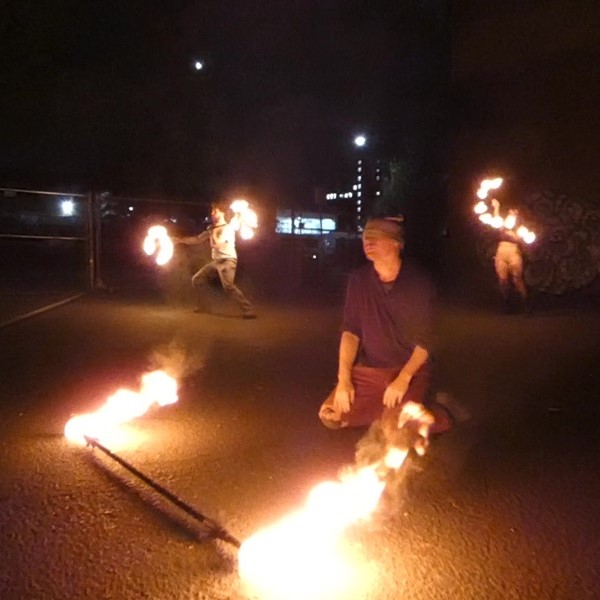
Cheshire corroborates; every time someone drops the prop and lets it stay down, they create a psychological wall that rewards surrender. And not the preferred type of surrender; not a surrender to action, but a surrender to inaction. The preferred order of operations is to work on a technique until it is understood, even in rudimentary form, and then put the prop down.
Even if it’s just for thirty minutes, an hour or a whole day, put the instrument down and let rest be the reward for mastering it just that little bit more. If practice does resume, let it end when the technique is just that bit more familiar.
In this waxing it’s pretty clear that I consider the staff almost as I would a person, and I do. They have a sentience all their own when in play and they’re not afraid to say when they have been disrespected by falling off the body or smacking me in the face. Conversely, when the act of play or performance is fulfilled, or the error is corrected, the staff hits every muscle as if it were kissing the skin.
And that’s where learning to move with the staff comes into play. To reduce the bruises and increase play time. To find a sustained style of movement that allows both the instrument and I to gambol and improvise in simpatico when we perform together.
Every error becomes an opportunity. Every awkward pinch point4 just becomes a new puzzle. From there I can joke, make a face, or emote. If I need the offhand to get the staff rolling again, that’s fine. I give it some serious look and push it across the body with a determination to not let any one mode of thinking define my performance or shatter my confidence. If the staff stalls, I flow with it, letting it guide me to whatever the next turn is.
In this way neither of us is the leader. We’re two equals, oil and water, perhaps separate but wholly connected; swirling dervishes, a pair of singularities, dancing with each other on a concrete parking lot called gravity.
I used to joke that a good burn with a contact or dragon staff is comparable to the best sex of your life. Now, it’s not such a joke anymore. It is just the joy of performance. The act may be ephemeral, but the emotion is invincible.
Finding a way to move into it all? That’s the key.
Patrons receive early-access to monthly poetry, short stories and short films as well as exclusive access to Patron-only short stories, poetry, and behind-the-scenes content. Every additional Patron lets me continue my dream of being a full-time creative, and I appreciate your support.
1 Groundwork is what it says it is; techniques designed for when a staff spinner goes to ground. There’s some absolutely insane full body rolls that a flow artist can accomplish down there. The type that requires insane flexibility, mobility, agility, and everything-ity.
2 Tutting is a little more difficult to explain, but it’s essentially geometric pathing. Alright that probably doesn’t explain it. Think of it this way: when a flow artist uses rigid props like staves or fans, they can create the outlines of a geometric object. Rectangles and squares are the rudimentary forms, but tutting can theoretically move into more complex polygons, parallelograms and such. The main draw of tutting comes from how a fire prop creates a “fractal flower” effect when spun on a single axis. You can see the flower effect with a camera on lower shutter speed/closing your eyes while watching. (Note: beginners should not close their eyes when spinning.)
3 Tracing is the act of tracing the body with the body of the prop. It’s very applicable to poi, a prop that uses cords to connect the handles to the heads/wicks. An expert poi spinner can snake the cord around the neck, shoulders, arms, legs, you name it. In the context of a staff, it’s a little more difficult because of the staff’s rigidity, but still possible and usually called a wrap.
4 A pinch point is a place on the body where the prop can be trapped and held between two separate parts of the body. Common pinch points include trapping the staff between the wrists, armpit, neck-and-shoulder, inside of the elbow or knee and the ankles.

 The Casual Ramble