
Began writing this after Project Pabst. It was intended to be a blog post but I couldn’t stop after the first 500 words. It works on a couple of things I’ve been playing with in my mind: time displacement, dialogue, character-building. Much of these aspects have been inspired by reading Isaac Asimov and Kurt Vonnegut and I noticed that my writing began to mimic their trademark dryness in spots.
Moreover, I’m not sure I really succeed in any one of those things. In French, I would say the execution is flou—fuzzy, in other words—but I’m also kind of fed up that I haven’t tried to practice those things. Hence the title. This, hopefully, is a change in tack, and at some point, I’m probably going to rewrite the middle portion and add more in the middle. For now, I’m willing to let perfection go in favor of just getting it out there.
As the doodah man once told me, you gotta play your hand because sometimes the cards ain’t worth a dime if you don’t lay them down.
A special thanks to my Patrons, Jennifer, Julie, Zero_Grav, Doji and Roshi. Without you guys, I probably would not feel confident enough to write and experiment and begin to work on the trade. Let this be the first of many.
I’m irritated. Exhausted. Fed up.
I’m tired of my brain waiting for a sign, but I’m nervous that I might miss it. All this waiting makes the days go long, but the weeks just keep growing shorter and shorter. It is two days past the end of Project Pabst and an interview needs to be finished. And yet, how can I think about that? I am currently working on my next masterpiece masterpiece masterpiece.
It’s a blog post. But I rarely sit down and type it. It is lost somewhere, in a journal. Half-completed because the next project starts tomorrow and yesterday was just notes for last week—soon to be forgotten, always behind schedule. Partly because that poem from two nights ago needs to be written right now to publish for never. Mainly because if I write anything, it better be good.
“No; it needs to be fucking perfect perfect perfect,” I say to myself, now, writing.
“Ask what you want of me, I am unable,” my headphones, then, sang to my ear, “cry with me, cry with me.”
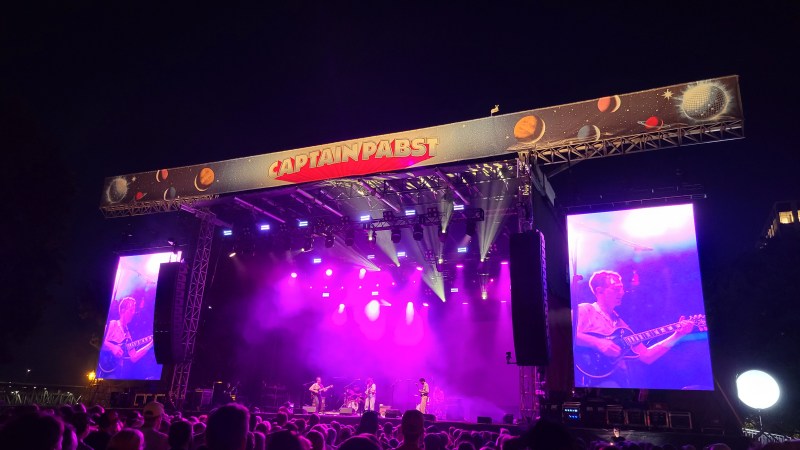
The drums inside still rung the alarm bell, sustained them like a cymbal. One part for great music, one part from tinnitus. Project Pabst was over, and I was pacing home, listening to Big Thief after having bid good night to my photographer, Leia and her partner good night. A bag of records twisted around the fingers of my right hand. A homemade nightcap burned in my left.
I’m not a Big Thief fan, but what I saw that night was exactly the music I wanted from Big Thief: heavy and jam-ridden. Far different from the vast majority of their studio work, but without the pitfalls of a jam band. Double drumsets fortified the back end of the stage, and Lenker walked out in a shirt, one-third tie-dyed, one-third white, one-third designed.
“Grateful Dead,” it read on the front; a sun and moon peeked over the star ridden font. “Summer Tour ‘92,” it showcased on the back; skeletons galore dotted the back, two Stealies crowned the double drumset. The rest was covered by Lenker’s guitar strap.
“I wonder where they got that tour shirt,” I jest to a man next to me when they finished their song, his tie-dye visible under the overalls.
“I don’t know,” he said curtly. I couldn’t tell if he was actually miffed that I would ask him the question or if he just needed no disturbance during live music. Still, I took whatever hint had been offered as Big Thief began to tune for their next song, another new one. They were not ones to introduce this or that, what is what. Like a true jam band, they just moved on to the next sequence.
But, I am stuck again, stuck in this living room-turned-office. The record of life skips, hops, jumps on this point and we are floating as the needle tries to find its groove. The mind tries to find the words. I tarry and diverge to the internet. The top post: “Breathless from Abattoir Blues.” I love that song.
Big Thief stops, a flute starts. Harping and naif and accompanied by more flutes. Harping and naif stumbles into the baroque. Eventually, this song ends, and the next one begins, and the next one. And now fifteen minutes have passed, and I am left wondering, wondering, wondering; are this and that comparable, or does this and that distract from the other?
Are Big Thief the Nick Cave of sad indie rock, or have I lost plot? What makes their recent dalliance into improvisation and drawn-out jams seguing into jams so much more palpably interesting than most other jam bands?
“Bah,” I say, back to the walk home; coming from the left of namesake Courthouse, I walked without fear of traffic. To my right, a stopped MAX sat in the distance. A green square shone from the placard, next to the words “Portland State University.”
“Not my ride,” I thought to myself; I didn’t even debate waiting for the Red Line train to arrive. The walk would resume from Portland’s living room to mine. The goal: to walk under the lights of Civic Stadium.
Pioneer Courthouse Square is an oasis at night; bereft of people and vehicles, only the food trucks remained in the brick amphitheater. Their windows were closed and series of fences had been moved to allow public access to most of the central stage. As I passed the food trucks, the streetlights reflected off the polish of the Umbrella Man, the dark bronze figure maintaining his watch over the plaza.
The gentle glow of STARBUCKS COFFEE announced the coffeeshop’s central position overlooking the amphitheater. The fountains that encircle the walkway to the TriMet visitor’s center had turned to naught but ponds. Rushing water had gone still and calm. Only the gentle rumble of the city disturbed the night. As if the turning gears of some giant machinery below had slowed but not stopped.
Crossing Broadway to follow Morrison, the music turned to a brighter, cascading set of guitars. The vocals became gated and lo-fi. An unexpected development, I thought to myself. A group of four waits for the next train by the Galleria. Two couples. One couple is wearing matching jerseys of green with gold stripes running down the shoulders.
“Did the Timbers win,” I asked, taking off the headphones.
“We did,” the jersey-wearing couple said in unison.
“It was a great game,” the male partner added.
His friend raspberried and threw his hands up. Clearly, a fan of the opposition.
“Look, I’m not saying Club Leon sucks,” I proffered the olive branch, “but we’re better.”
After a sensible chuckle and a good night bidden on all sides, I kept moving onward. And in this moment, writing, I remembered why Big Thief surpassed the standard of most jam bands.
The Grateful Dead is to jam bands what Star Wars is to science fiction. Both are a complex mixture of more than just jams and lysergic acid, more than just laser swords and hyperspace. Imitators must understand: if the Grateful Dead or Star Wars are the sole inspiration, then the inspiration is weak.
The former is a deep dive into the American ideal via twelve-bar blues, scriptural imagery, beatnik storytelling, and rosy doses of lysergic acid. The latter is a retelling of the Hero with a Thousand Faces that invokes fifties sci-fi series, Japanese samurai films, Western ikon, and Daoist philosophy. Both go deep into questions of sociological, and somewhat theological bearing. Robert Hunter’s lyricism interprets parables of the American ideal. George Lucas’ films illustrate the commonality of folk idolatry.
Eventually, each expands beyond their base foundations into other areas. For the Grateful Dead, they move into funk and reggae (they even dabble with hip-hop!); for Lucas, it’s a pivot from the brittle structure of tyranny to the fragility of democracy (an Asimovian fascination). Each did so to mixed critical responses but, because the foundations were rooted so deeply, imbibing sources so profoundly within cultural legend, that they had the luxury to do so regardless. The foundation was set for the bridge to cross.
As I walked up Morrison, the ambient rumble of the city transformed into a suite of swooshing, whooshing cars on the interstate underfoot. In the distance, the suspension arch of the Fremont Bridge beguiled like stars in the city scape.
The music was still fuzzy lo-fi. I did not expect this direction from Big Thief. The drum acoustics moved from roomy staircase to professional studio space. The guitars alternated between the gauze of scuzzy tone or the tube-light glow of melodies. This couldn’t possibly be Big Thief, but the nineties nostalgiawave wass pleasant enough that changing it would be a crime to personal enjoyment.
I passed the train stop in front of Civic Stadium and then arrested all momentum at the red right hand of a crosswalk light.
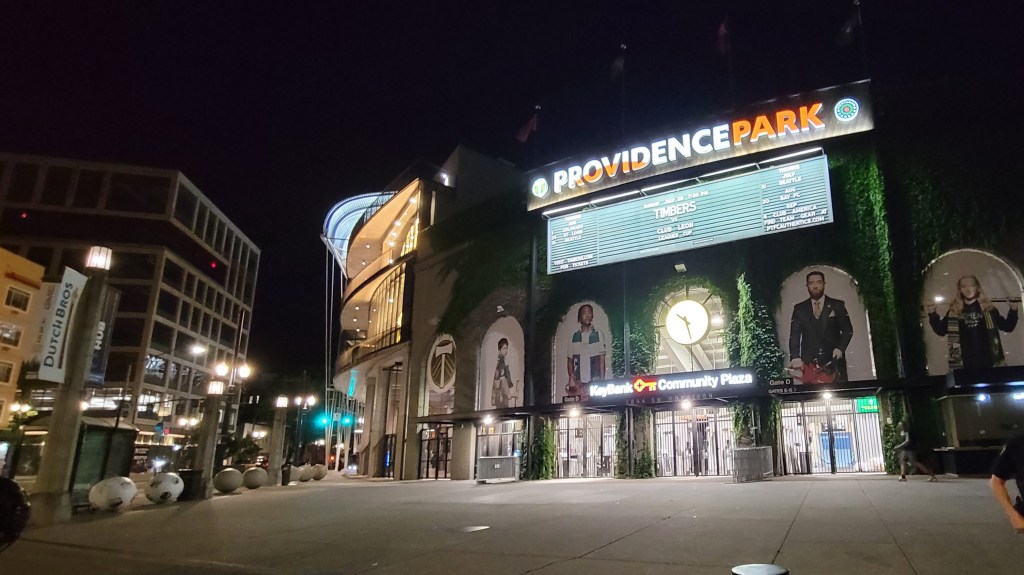
Poster models posed, postured and positioned atop the ivy covered archways into the arena, wielding axes and chainsaws. A mass of crisscrossing bronzework sculpted into human visage sits in front of the entrances, as large polished granite boulders line the square in front of the ticketing office.
The marquee reads the match of the day. SUNDAY JULY 28 7:30 PM it prefixes above the contestants. LEAGUES CUP it subtitles under them. TIMBERS reads largest of all. However, the marquee was outclassed by the words PROVIDENCE PARK stretching along the curve of the arena’s historic facade in luminous white and orange.
All I can do is bask in the sight of Portland’s Circus Maximus, the site of Civil Wars, minor-league baseball and soccer was now the veritable Highbury of the Pacific Northwest. As I look further up, the Big Dipper still peeks through the night sky. The light changes from a red right hand to the walking man and I shake my head, realizing my mission again, realizing that the arena’s portion of Morrison is a closed road during Match Day.
As I crossed the street, a security guard looking down Morrison motioned towards something out of sight, giving an audible “tsk!” and then pointing to me. I turned my head to my right and see a van signaling left.
“Thanks for looking out for me,” I said to the officer.
“Just doing my job,” he replied. I head towards Burnside, walking past a bar full of Timbers patrons gathered for a post-match drink.
“Wait,” I realized, “I’m going the wrong way.”
I wanted to walk under the lights of Providence Park, not around them. Cursing my attention span, I turned the corner. A small promenade would take me back to the arena’s familiar facade. As I walk up the steps, the stadium lights come alive again and I resolve to take a picture. Two police officers stand by the granite globes. They are cloaked in the modern apparatus of the police, vests with all manner of pockets. Radios on their right shoulders I snapped a couple pictures, but as I turned to leave, a weight sank on to my shoulders.
“You guys don’t mind if I took your picture,” I turned to the officers.
“Go ahead,” the officer on the left says.
“We’re in a public space, you can take whatever pictures you want,” his partner to the right adds.
“Fair point,” I say with a laugh, “I heard it was a good game tonight.”
“I guess so.”
We chat a little further and exchange names. For the sake of anonymity, Pascale and Raleigh. I tell them I’m a writer, describing that I’m using my walk home from the Waterfront as the template for a short story on my blog and giving them all of the details of my racket as if it were a networking opportunity. Weirdly, it feels like a practice.
“What do you write about?” Raleigh asked.
“Oh, y’know, mostly music, the Trail Blazers, the life in Portland.”
“Must be pretty hard to write about the Trail Blazers right now,” he said.
“Ah,” I replied, not exactly denying the charge, “yeah, but at least its fun to see all the new talent, the new era. All that. Big issue is that we still have enough talent to be better than the worst teams in the East.”
“I remember when they won the Western Conference finals,” Pascale waxed, “I was trying to call my friends and the phone lines were all down because people were freaking out.”
“You think they’ll ever win it again?” Roberts mused.
“If Milwaukee can win another, then I think we’ve got a shot,” I shrugged.
Realizing the time, I began my goodbyes; “Well, it’s good to get a face to the force so I’m not just laying into you guys online.”
“Yeah, we’re people, too,” Raleigh chuckled, “we’re just here as public servants.”
“Well, y’know,” I jest, “the Supreme Court did say ‘protect and serve’ is a marketing slogan, not an actual obligation.”
“Great, now I have a reason to not do my job,” Raleigh jests back.
“Well, look at me and my Puckish ways,” my tone turns matter of fact, “disillusioning the police bureau, one officer at a time.”
Our laughter is nervous, not because of some misplaced mistrust but because the issue itself was as nervous as it was absurd. And the only proper response to the absurdity was to rebel, to laugh. So we laughed and we rebelled and then we parted.
And now I am writing again, wondering if it is fair to expect a profound review of myth and society from any new jam band? Of any new science fiction universe? Perhaps not; I’m willing to admit that it would be suicidal for any modern group, be it Phish, Pigeons Playing Ping-Pong or Goose, to copy or imitate those legendary influences. Perhaps that’s why they choose to specialize in the specific format of the music more than any thing else.
The existence of the trail blazer does imply a standard, however, that the artist or the ahem informed consumer (retch) can either accept, reject or ignore. For artists of any medium, it’s probably best to ignore these standards in order to nurture their creative permissions. But that that doesn’t mean non-musicians will stop grading musicians by these standards.
Big Thief meets the standard because they are unequivocally not a jam band. Buck Meek is a central Texas folk guitarist who busked his way through New York. James Krivchenia is a trained studio engineer turned drummer making experimental electronica in his free time. Adrianne Lenker is a singer-songwriter who recorded her first record at age 13 and attended Berklee College of Music on a scholarship before launching her solo career.
These three have a pedigree for the unconventional apart. Together and on stage at the Tom McCall Waterfront, the group transmuted from the purveyors of independent folk-rock into live sonic explorateurs who redefined the geography of their music. Their compass rose sounded out new cardinal directions: American primitive guitar, chamber music, bluegrass, and forlorn folk. This newfound compass signaled the band to undertake healthy adventures into the roots of their sound and triangulate music out of space.
Perhaps those directions are key; as for musical traditions, they are roughly equatable to the same roots of the Grateful Dead, who first percolated as a jug band playing blues in small clubs across the Bay Area.
“Clearly, what we’ve explored here, now,” I say after writing, “is not that Big Thief passes any standard of quality, but that they have finally met a criteria of agreeable taste.”
I sigh. It’s true. Perhaps there is no real standard, that there are only influences, formats, instruments and technology; that bands are a reflection of their time, not a harbinger of it. Perhaps the truth is that Big Thief simply found something that can only exist in a live context, but never on their records. It seems so trivial an answer.
When I arrived home and unlock the door, Sir Charles greeted me, “miaou!”
“Whoa, dude, I get it—dinner’s late, tonight.”
I set down my things and moved to kitchen, reaching for a can of wet food and cracking it open. Once it was presented for Sir Charles’ approval, I sat down at my desk. There was a day recap to write. An interview to edit. I pulled out my phone.
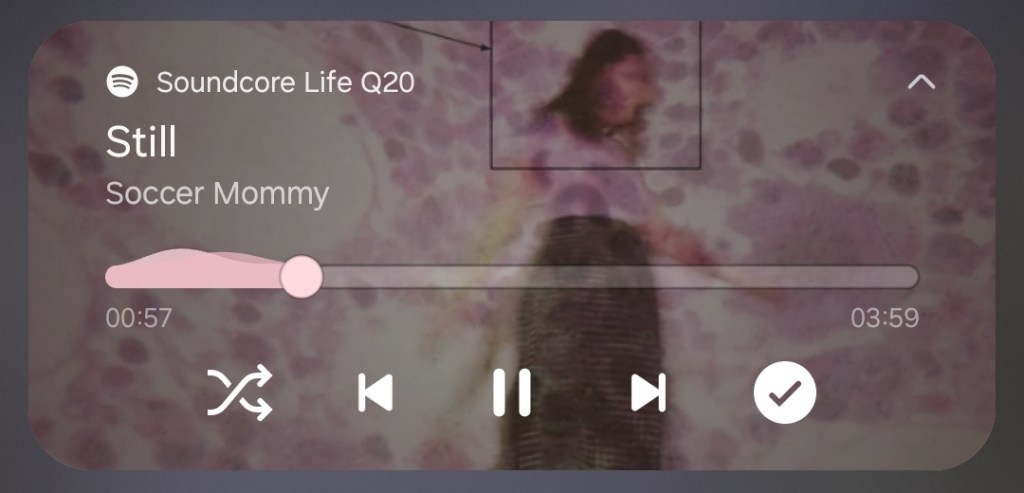
“Soccer Mommy – Still,” it read on the notification bar.
“Figures,” I said to myself, fed up that I didn’t catch this change in artists earlier. How was I going to write about Big Thief now, I asked myself. But I was home, the city of Portland had shrunk to just one apartment. Sir Charles’ jumped on my lap and began to purr.
Hey there! Casual Rambler here, just wanting to thank you for reading my blog. I try to avoid marketing myself and I don’t like paywalling content. That’s why most of this website, if not all, is free. However, subscribing to my Patreon helps me keep doing it. Patrons gain exclusive short stories as well as early-access to monthly poetry and photography posts. Thanks again and please enjoy the rest of the site!

 The Casual Ramble